
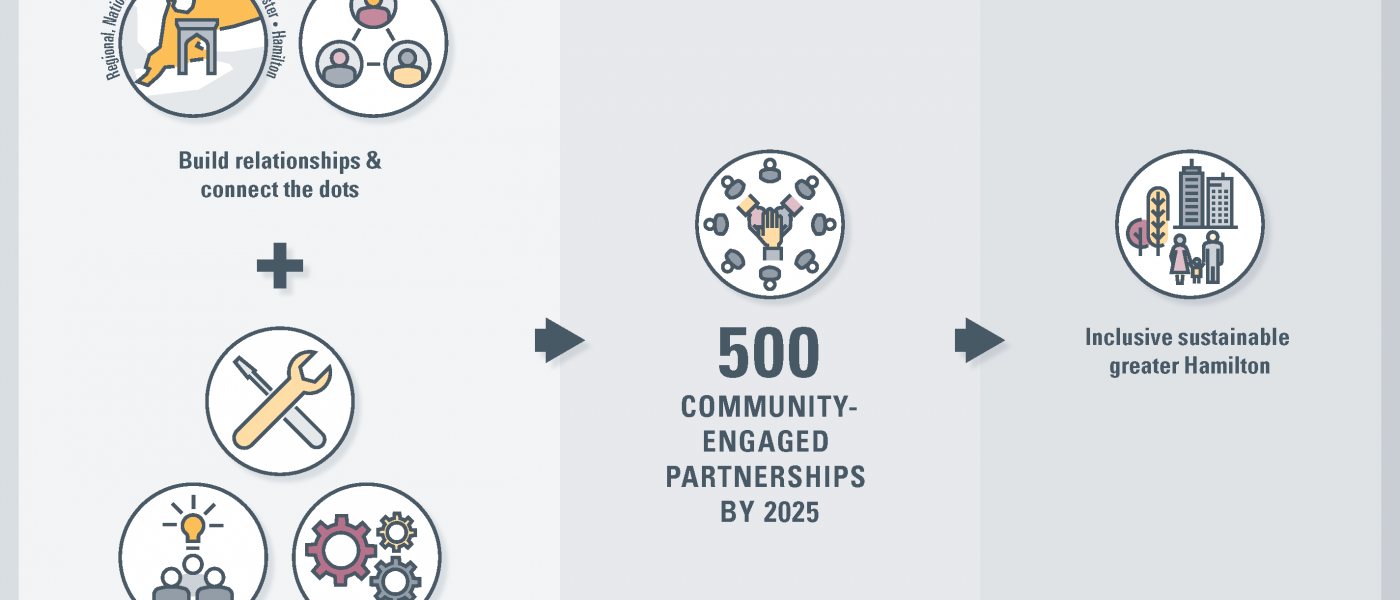
Current Strategic Plan
Overview
In June 2016, McMaster’s Community Engagement Strategy was launched to set the direction for the next 5 years of community engagement at McMaster. The vision of this strategy is working together for an inclusive, sustainable greater Hamilton. McMaster’s Office of Community Engagement was formed to support the pursuit of McMaster’s Community Engagement Strategy.
Action-oriented principles of community engagement were co-developed between community and campus partners to provide a framework for how to work together. The principles include: relationships, reciprocity, equity, continuity, openness to learning, and commitment to act.
The primary goal of McMaster’s Community Engagement Strategy is to establish these principles as the foundation of community-campus partnerships.
To build on the foundation of the existing strategic plan, our office participated in the Impact and Strategic Clarity module offered by Innoweave through the J.W. McConnell Family Foundation from September 2019 to April 2020. Our objectives in completing the module were to i) clarify our mission (i.e., what we are trying to achieve and what we will hold ourselves accountable to); and ii) develop a new 5-year strategic plan that would articulate how we will achieve this mission and the results we are striving to have both locally and globally.
 Our Mission
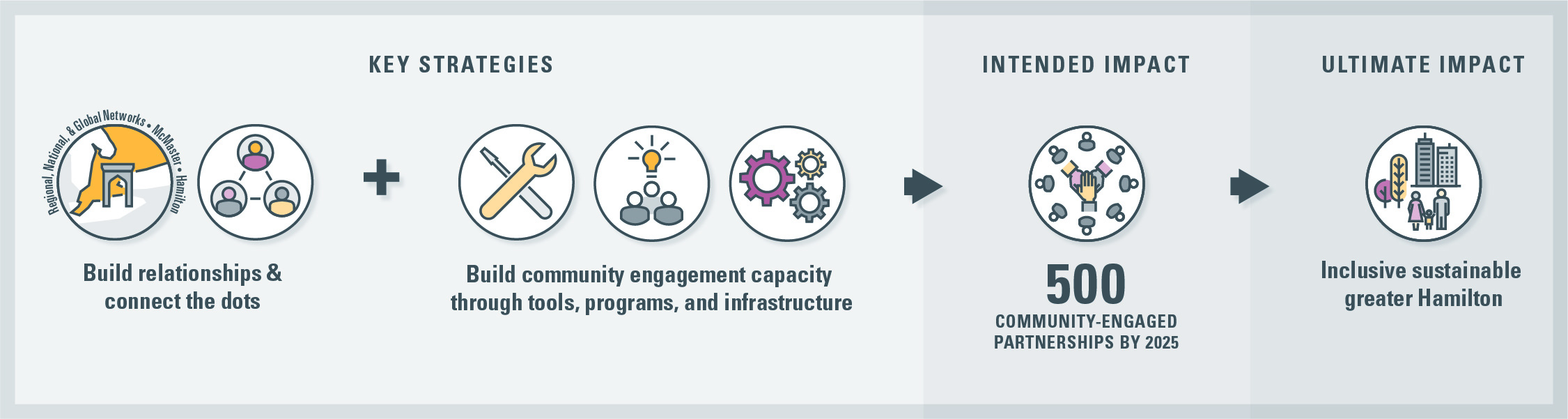
By 2025, McMaster University will have 500 community-engaged partnerships that are addressing community— and university— identified priorities, built on respectful relationships, mutually beneficial, equity-seeking, and adequately resourced.
Our New Strategic Plan
Our new strategic plan outlines five key strategies to build community-engaged partnerships and achieve our intended impacts. Many objectives of our first strategic plan are ongoing and connect with this next phase of community engagement at McMaster.
Vision
Working together for an inclusive, sustainable Greater Hamilton
Mission & Strategies
Our new strategic plan outlines five key strategies to build community-engaged partnerships and achieve our intended impacts. Many objectives of our first strategic plan are ongoing and connect with this next phase of community engagement at McMaster.
Our Mission
By 2025, McMaster University will have 500 community-engaged partnerships that are addressing community— and university— identified priorities, built on respectful relationships, mutually beneficial, equity-seeking, and adequately resourced.
Our Strategies
We can’t have community without relationships—these are the connections that build community. Any successful partnership must be built on trusting and respectful relationships guided by integrity. We realize that relationships take time to develop and thus we commit to providing opportunities to connect people across communities, sectors, and disciplines to foster a genuine and interconnected network of colleagues to work together for an inclusive, sustainable Greater Hamilton Area.
Our role is to
- Create opportunities for campus and community partners to connect.
- Create opportunities for relationships to be built across campus.
- Attend community, faculty, and major unit events or meetings.
- Monitor issues and opportunities.
- Identify priorities to support.
- Connect with regional, global, & national community-engaged networks.
Our team develops our relationships and connections to identify opportunities for McMaster University to respond to community priorities through research, education, or service. Relatedly, we respond to requests from faculty, staff and students interested in community connections for learning, research and volunteerism. We listen to ideas that are brought to us and actively connect people together who have shared interests with the goal of building new community-campus partnerships.
Our role is to
- Make introductions or broker partnerships around shared interests or aligned timelines.
- Identify how resources, partnerships, or programs can address community- and university-identified priorities.
- Identify and agree upon Faculty community engagement needs and partnerships.
Our team is comprised of expert community-engagers, educators, and researchers working to share their knowledge, resources, and expertise to improve community-engaged practices and processes.
Our role is to
- Create and deliver community engagement resources such as workshops, webinars, guides, handbooks, literature, slide shows for faculty, staff, and students.
- Raise awareness of OCE as a resource to facilitate relationships.
- Identify activities, processes, and tools used in other institutions and communities.
- Support and facilitate faculty, staff, and community partners in using tools and resources in their programs, projects or initiatives.
Together, we work to develop and support community-engaged programs that orient McMaster resources towards partnerships that embed McMaster’s principles of community engagement.
Our role is to
- Provide direct support to priority community engagement programs or initiatives, new or existing, within major units and within each faculty at McMaster.
- Develop and sustain programs within the OCE that build individual and program-level capacity for community-campus partnerships.
Our team is also working to establish sustainable University-wide infrastructure: funding, staff, policies, protocols— to support community engagement activities.
Our role is to
- Develop the OCE as a core community engagement resource at McMaster.
- Develop the Network for Community-Campus Partnerships as a coordinated decentralized approach to formalizing community engagement processes at the University.
- Recognize and celebrate community engagement accomplishments and milestones.
- Reduce identified barriers.
Pillars of Community Engagement
A variety of approaches are needed to support community partners as well as McMaster students, faculty, and staff who are interested in developing skills and competencies for principled, sustainable, and reciprocal partnerships. It is also crucial to develop sufficient structures and policies for recognition which will ensure that we are supporting, acknowledging, and encouraging those who pursue community-engaged education or research partnerships.
A major barrier to any partnership development is that people (both partners and colleagues at McMaster) do not know where to go, who to talk to, or what resources exist to support partnership building. There is a need to improve access to (and awareness about) both physical spaces (on and off campus) and virtual spaces that can help partners use these pathways to navigate community-campus partnerships.
This pillar will focus on improving awareness of the work of community-engaged individuals, research and education outcomes, available resources, and upcoming opportunities and events. Communicating in plain language, being clear about steps that partners can take to engage, developing visual pathways for engagement, maintaining the community engagement database, and raising the profile of community liaisons across the University can improve partnership opportunities and outcomes.
Organized in partnership with community and campus partners, face-to-face meetings on specific themes or topics will support relationship building and ongoing relationships that can lead to potential partnership opportunities. Tying funding opportunities to specific topics can encourage ideas to move towards projects, while sharing outcomes of conversations or the conversations themselves (e.g. in an online repository) can encourage others to connect to ideas while also informing actions going forward.
Principles of Community Engagement
Learn more about our principles of community engagement in our online sourcebook